The AI Experimentby Xelec

Xelec hardware engineering

IoT, embedded and electronics product development.

Firmware, boards, sensors and connected devices — engineered for production, not for the demo table. The same team that lets our AI run where the cloud cannot reach.

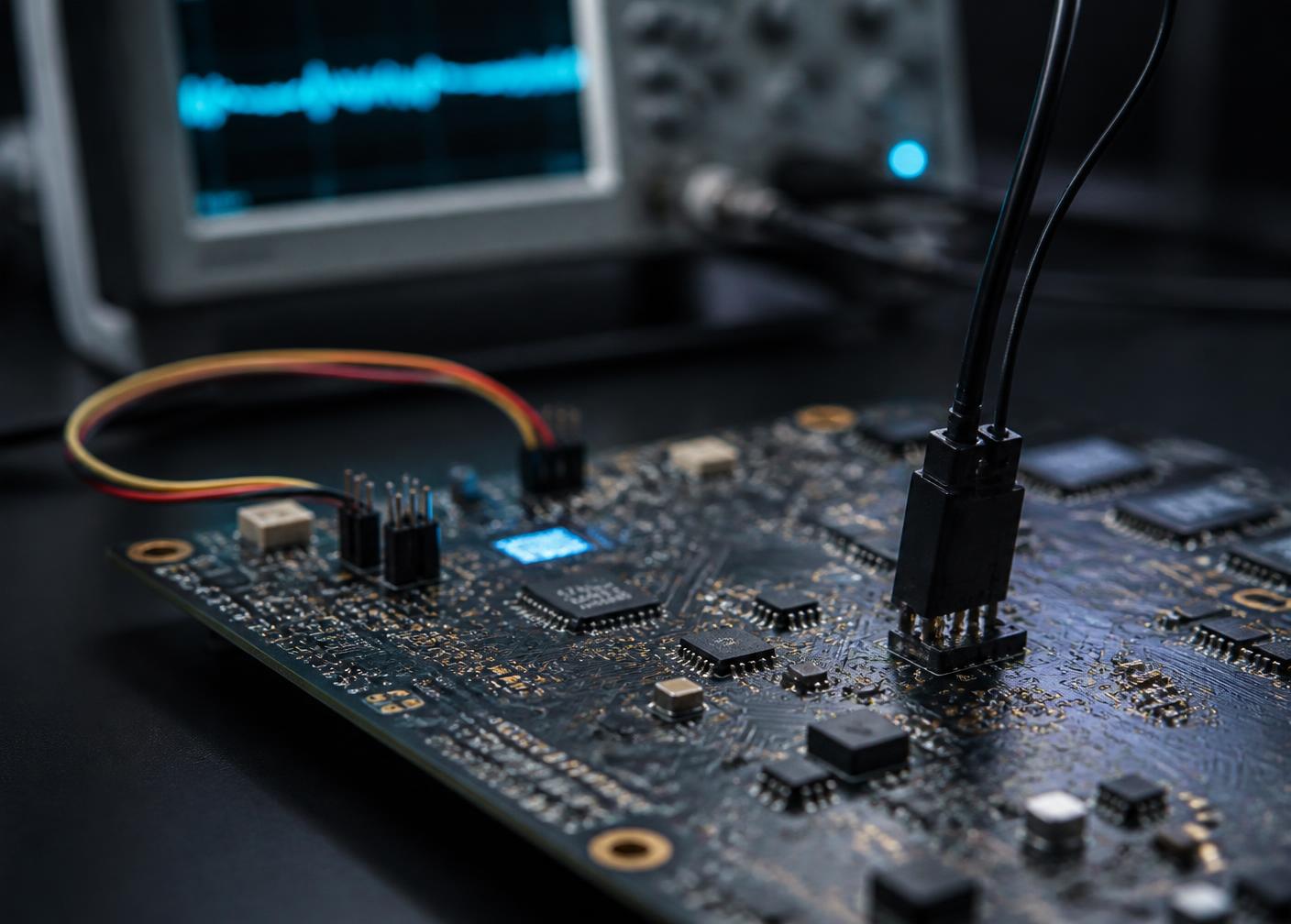
Custom embedded board under bring-up on a lab bench with a debug probe attached and an oscilloscope trace behind it

Capability

One team from schematic to shipped fleet.

Most product programmes lose months in the handovers — design house to firmware contractor to manufacturer, each blaming the last. We hold the whole chain, so the trade-offs get made once.

6 wks
Typical concept to working prototype
11 lines
Largest deployed device fleet
38 ms
Median on-device inference
You own it
Schematics, layout and firmware

Figures on this page are illustrative placeholders pending verified capability data.

Six services

What we are asked to build most often.

Each engagement is scoped to a physical deliverable: a unit that runs, a design package a manufacturer can quote, a fleet you can update.

H-01

IoT systems

A connected product that works on the bench and falls over as a fleet.

End-to-end connected systems: device, gateway, connectivity and the telemetry pipeline behind them. Provisioning, identity and secure OTA are designed in at the start, because retrofitting them onto a deployed fleet is where most IoT programmes stall.

Deliverables

  • Device and gateway architecture
  • Provisioning and OTA path
  • Telemetry and fleet dashboard

H-02

Embedded prototyping

You need proof the thing can exist before anyone will fund it.

Concept to working prototype: dev-kit bring-up, breadboard rig, first custom PCB, and an honest feasibility read on power, thermal, size and unit cost. The output is a device you can put in front of a customer or a board, plus what it would cost at volume.

Deliverables

  • Working prototype unit
  • Feasibility and cost model
  • Component and supply plan

H-03

Firmware development

Firmware written once, then nobody can safely change it.

Bare-metal and RTOS firmware, board support and drivers, bootloaders with secure boot and signed updates, low-power state machines, and connectivity stacks. Written with a test harness and hardware-in-the-loop rig so the tenth revision is as safe as the first.

Deliverables

  • Firmware source and toolchain
  • Secure boot and OTA
  • HIL test rig and CI

H-04

Electronics product development

A prototype that no contract manufacturer will quote against.

Schematic capture, PCB layout, signal and power integrity, mechanical and enclosure coordination, design-for-manufacture review, test-fixture design and certification preparation. The deliverable is a documented design package a manufacturer can build from.

Deliverables

  • Schematics, layout and BOM
  • DFM and test fixtures
  • Certification preparation pack

H-05

Sensor and edge AI integration

The model is blamed when the capture was wrong all along.

Vision, acoustic and vibration capture specified alongside the model that consumes it — optics, framing, lighting, sampling rate and synchronisation chosen for accuracy. Then the distilled model, quantised and validated on the target silicon under sustained thermal load.

Deliverables

  • Sensor specification
  • On-target model package
  • Accuracy and latency budget

H-06

Sustaining engineering

A shipped device with no one left who understands it.

Board revisions, component obsolescence and second-source swaps, firmware maintenance, field diagnostics and fleet health reporting. Devices live for years; the engineering has to as well.

Deliverables

  • Revision and errata management
  • Second-source strategy
  • Fleet diagnostics and reporting

How an engagement runs

Five stages, each with an exit you can inspect.

You can stop at any stage and walk away with the artefacts. Nothing is contingent on signing the next phase.

  1. 01

    Discovery

    Constraints first: duty cycle, power budget, environment, certification target, volume and landed cost.

    1–2 weeks

  2. 02

    Prototype

    Dev-kit or first custom board, firmware skeleton, and a working unit that proves the risky part.

    4–8 weeks

  3. 03

    Design for production

    Layout hardening, DFM review, thermal and power validation, test fixtures and certification preparation.

    6–12 weeks

  4. 04

    Pilot fleet

    A small production run in real conditions, instrumented, with OTA and diagnostics already live.

    4–8 weeks

  5. 05

    Volume and sustaining

    Transfer to manufacturing, then revisions, sourcing changes and fleet operation under an agreed SLA.

    Ongoing

Why both under one roof

The model and the machine, decided together.

An AI company will send you a cloud API. A design house will send you a board. Neither owns the trade-off between accuracy, latency, power and unit cost — which is the only decision that matters once a device has to ship.

  • Capture designed for the model

    Sensor choice, optics and sampling specified against the accuracy target, instead of the model being handed whatever the hardware happened to produce.

  • Compute sized to the workload

    Silicon selected after the distilled model is profiled, so you are not paying for an accelerator you never saturate — or discovering you undersized it at pilot.

  • Data that never leaves the site

    Inference at the station means the imagery, audio or documents stay on your network, and the audit trail is local. A residency answer that survives legal review.

  • One accountable team

    When accuracy drops in the field, there is no argument about whether it is the model, the firmware or the sensor. Same team, same contract.

Next step

Bring the constraint, not the spec sheet.

Cycle time, power budget, certification target, landed cost — tell us what the device has to survive and we will tell you whether it is a four-week prototype or a twelve-month programme.