Parent company
Xelec: the reason our AI can leave the data centre.
Software companies stop at the API boundary. We keep going — into the board, the sensor and the production line.
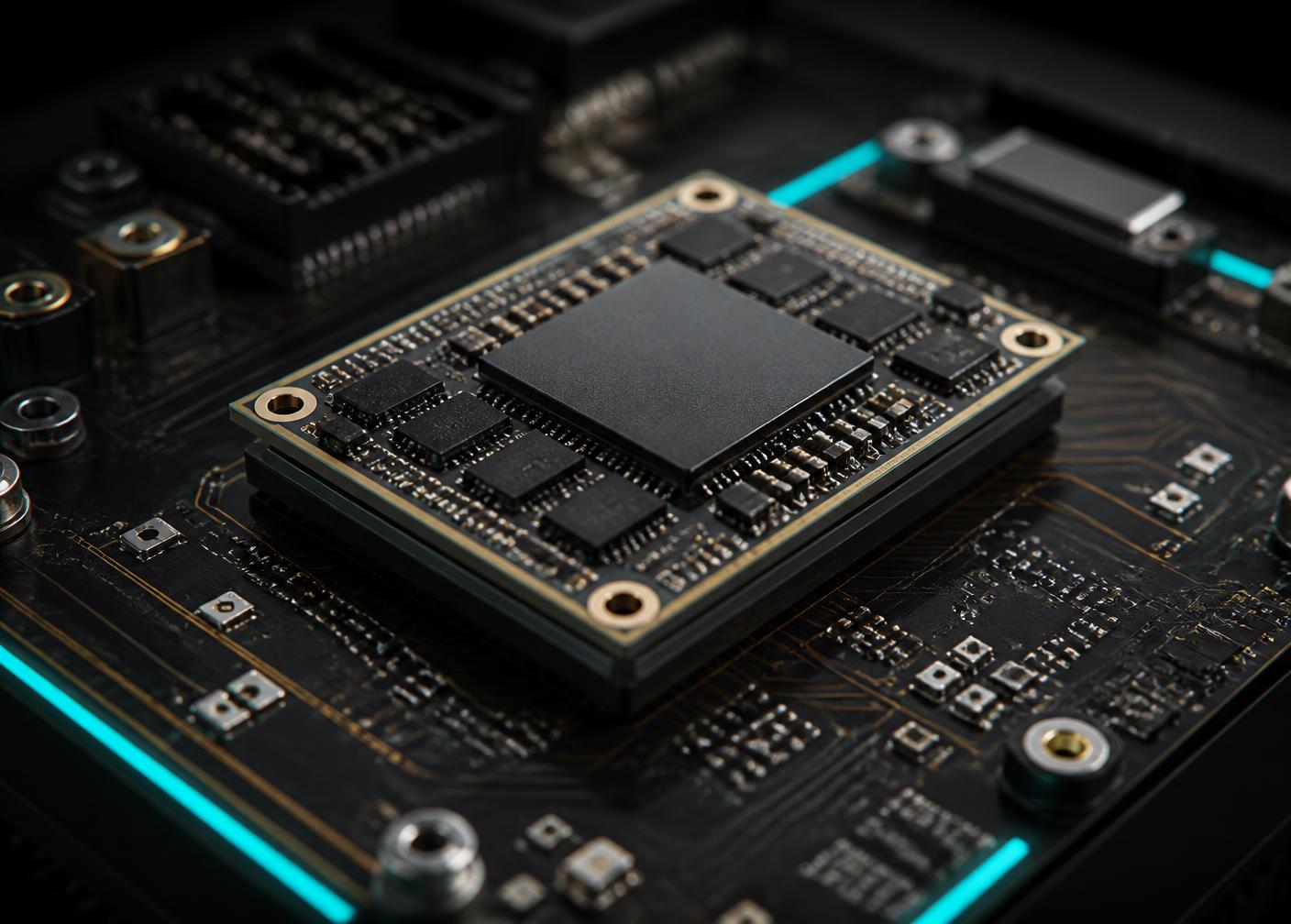
Capability
Model and machine, decided together.
Accuracy, latency, power and cost cannot be traded off across two separate companies.
What the hardware team does
Four capabilities you cannot buy from a model vendor.
Embedded design
Schematic and PCB design, component selection under real supply constraints, production bring-up.
Sensor and capture integration
Vision, acoustic and vibration capture designed alongside the model that consumes it.
Thermal, power and compliance validation
Sustained-load testing, power budgeting and electrical compliance for industrial sites.
Manufacturing and fleet operation
Reference design to volume, then OTA updates, diagnostics and store-and-forward telemetry.
Services you can buy
Hardware engagements, with or without AI.
IoT, embedded prototyping, firmware and electronics product development, as standalone programmes.
H-01
IoT systems
A connected product that works on the bench and falls over as a fleet.
H-02
Embedded prototyping
You need proof the thing can exist before anyone will fund it.
H-03
Firmware development
Firmware written once, then nobody can safely change it.
H-04
Electronics product development
A prototype no contract manufacturer will quote against.
H-05
Sensor and edge AI integration
The model gets blamed when the capture was wrong all along.
H-06
NVIDIA Jetson edge AI builds
A vision model that only ever ran on a workstation GPU.
H-07
Digital twins of your environment
Decisions about a site made from spreadsheets and memory.
H-08
Sustaining engineering
A shipped device with no one left who understands it.
Why it matters commercially
Sovereignty stops being a compromise.
Others answer residency with a region selector. We can answer it with a device.
Regulated environments
Clinics, plants and public-sector sites where off-site processing is simply not permitted.
Bandwidth-constrained sites
Remote facilities, vessels and field operations where uploading raw sensor data is not viable.
Latency-bound processes
Line inspection and safety interlocks with cycle times measured in tens of milliseconds.
Cost at volume
Continuous inference on thousands of streams, where cloud pricing never converges.
Next step
Does your use case need to run on site?
Bring the constraint — cycle time, bandwidth, sovereignty rule — and we will tell you if hardware is the answer.